Edit Template

Author name: prashanthdevm

Why is Product Backlog Refinement not considered an official Scrum Event?. Agile and Scrum Master Training online by ScrumMaster.Tech
Blog

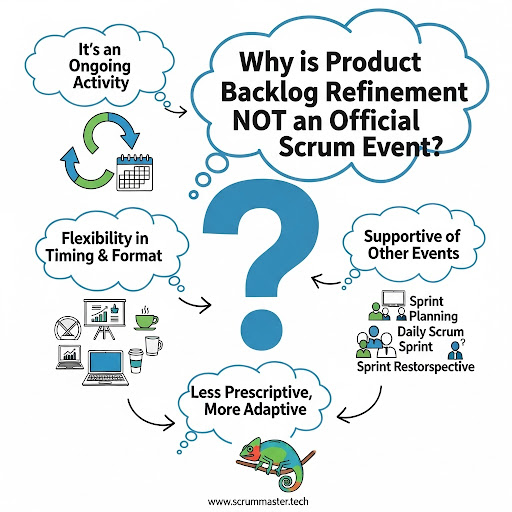
Why is Product Backlog Refinement not considered an official Scrum Event?

Because Scrum deliberately keeps the number of formal events minimal to ensure focus and flexibility. In the Scrum Guide, the official events are: But what about Product Backlog Refinement? It is an important activity, but it’s not a formal Scrum event. Here’s how the Scrum Guide (2020) describes it: “Product Backlog refinement is the act of breaking down and further defining Product Backlog items into smaller more precise items. This is an ongoing activity to add details, such as a description, order, and size.” Key Points: Aspect Description Is it required? Yes — to keep backlog ready for future sprints Is it time-boxed? No — teams choose how much time to spend (usually 5–10% of Sprint time) Who participates? Product Owner, Developers, Scrum Master (facilitates if needed) When is it done? Anytime during the Sprint — usually scheduled mid-sprint or just-in-time Why not an official event? Scrum favors flexibility — teams decide how and when to refine. Think of it this way: So it’s essential, but not formal. Analogy: You clean your kitchen regularly — it’s important.But it’s not on your daily family calendar like dinner or school runs.Same with refinement — critical, but informal.

Agile and Scrum Master Training online by ScrumMaster.Tech
Blog

Velocity Is Not Value: Reframing Agile Metrics That Matter

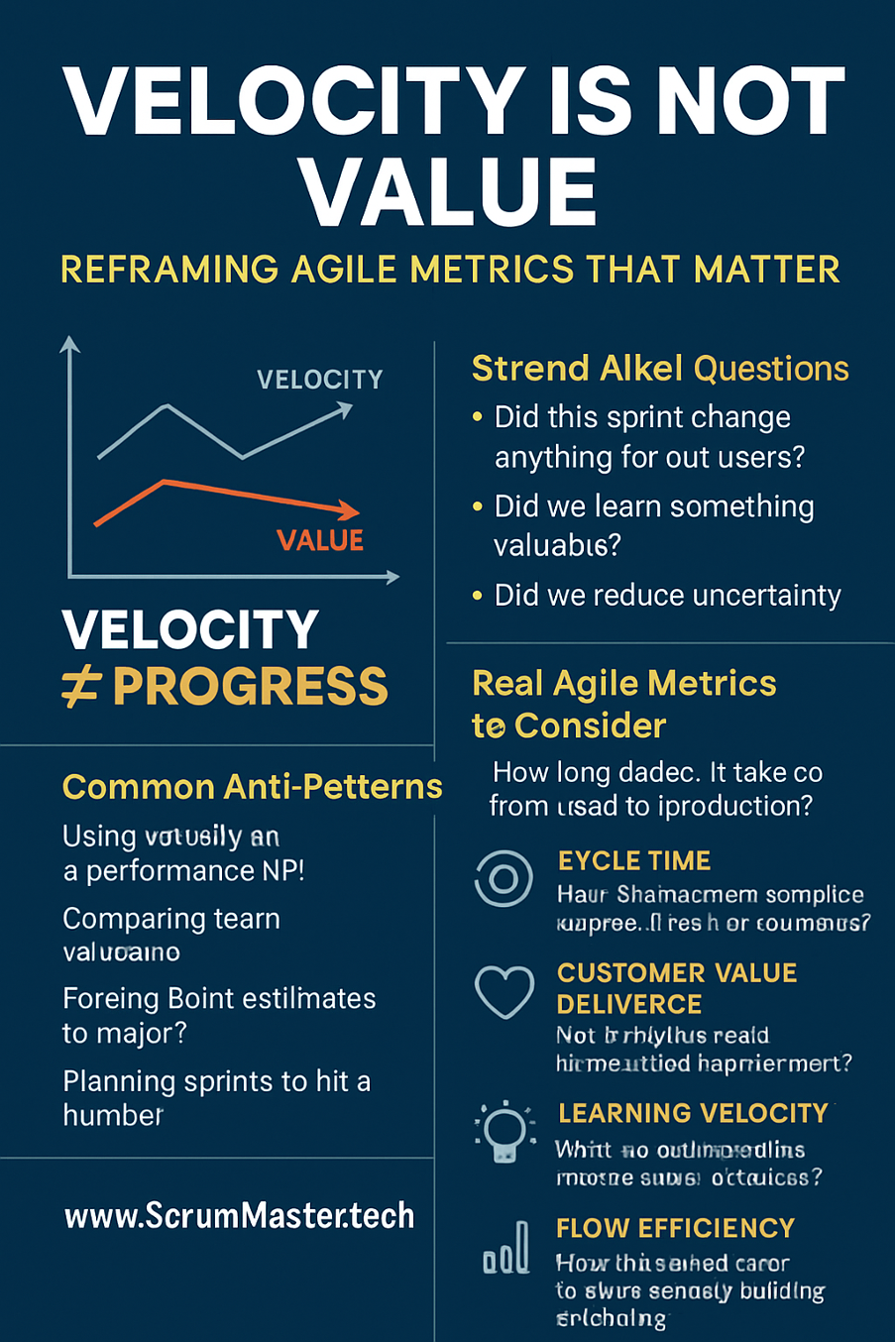
Velocity.That sacred number we display on dashboards.That trend line we present in reviews. But here’s the brutal truth: Teams can hit their velocity target and still deliver zero value. I’ve seen teams sprint hard, burn story points like champs…Only to discover that what we built wasn’t needed, wasn’t used, or wasn’t usable. Velocity ≠ Progress Velocity is a measure of motion — not of meaning. We’ve confused speed with significance.Just because we’re moving, doesn’t mean we’re moving in the right direction. Let’s Ask the Real Questions Instead of: “Did we hit our velocity goal?” Try: Common Anti-Patterns Anti-Pattern Why It’s Harmful Using velocity as a performance KPI Encourages gaming the metric Comparing team velocities Violates team autonomy & context Forcing point estimates to match Creates false precision Planning sprints to ‘hit a number’ Ignores actual need & flow Real Agile Metrics to Consider How long does it take to go from idea to production? How fast can a team complete a piece of work once it starts? Did this sprint result in real-world improvement? What did we learn that informs better decisions? How much of our time is spent actually building vs. waiting? A Shift I Made as a Scrum Master In one org, leadership was obsessed with points.Sprint after sprint, teams “performed” well — but usage dropped. So I ran a silent retro: “If velocity were invisible, how would we measure success?” The results were raw: That was the moment we stopped estimating and started evolving. What You Can Do As an Advanced Scrum Master Takeaways Final Thought from Coach: “Agile is not about doing more. It’s about doing what matters — and doing it wisely.” More insights at: www.ScrumMaster.tech/knowledge-hub  

The Dark Side of Agile. Agile and Scrum Master Training online by ScrumMaster.Tech
Blog

The Dark Side of Agile

Agile is often portrayed as the hero in the story of modern software development — the cure for bureaucracy, inefficiency, and disengaged teams. And to a large extent, it is. When done well, Agile empowers teams, shortens feedback loops, and delivers real value faster. But like any methodology or movement, Agile has a dark side — not because the principles are flawed, but because of how they’re applied (or misapplied) in the real world. As experienced Scrum Masters, it’s our job to acknowledge this reality, not shy away from it. Only then can we guard against it. 1. The Cargo Cult Agile Trap Teams sometimes adopt the rituals of Agile without embracing its principles. Stand-ups happen every morning, backlogs are filled, sprints are planned — but decisions are still top-down, and there’s little real empowerment.This “cargo cult” approach gives the illusion of agility while preserving the same old command-and-control culture. Over time, it breeds cynicism among team members: “Agile is just more meetings with less freedom.” 2. Weaponized Transparency Agile thrives on openness — visibility into progress, challenges, and priorities. But in the wrong hands, transparency becomes a weapon.Burndown charts are used to publicly shame underperforming developers. Sprint reviews turn into interrogation sessions. Retrospectives become blame-fests instead of safe spaces.When metrics and visibility are used to punish rather than improve, Agile becomes a tool of micromanagement, not empowerment. 3. The Illusion of Speed Stakeholders sometimes see Agile as a license to deliver faster — much faster. Instead of using Agile to balance pace with quality, they pressure teams to deliver “MVPs” that are barely functional, then rush the next feature before feedback is even processed.The irony? This race to go faster often slows delivery in the long run because of tech debt, rework, and burnout. 4. Agile Amnesia Agile encourages adaptability — but constant pivoting can lead to instability. Some organizations overreact to every stakeholder request or market shift, abandoning long-term vision for short-term wins.The team becomes stuck in an endless loop of starting new things without ever optimizing the existing ones. The result: high activity, low actual value. 5. Scrum Masters as Process Police In unhealthy Agile environments, the Scrum Master can be reduced to a rule enforcer — obsessing over timeboxes, templates, and “doing Scrum right” — while ignoring the real goal: helping the team deliver value and improve continuously.When the framework becomes more important than the outcome, the spirit of Agile is lost. The Role of an Experienced Scrum Master As an experienced Scrum Master, you’re not just a facilitator — you’re a cultural guardian.Your role in preventing Agile’s dark side involves: Agile is not a silver bullet — it’s a mindset that can be twisted into something harmful if left unchecked. Our responsibility is to ensure that doesn’t happen. Final Thought:The dark side of Agile doesn’t come from the framework — it comes from people misusing it. As a Scrum Master, your superpower is to illuminate that dark side and guide your team back into the light. www.ScrumMaster.tech

Agile and Scrum Master Training online by ScrumMaster.Tech
Blog

The Art of Asking Questions: A Scrum Master’s Quiet Superpower

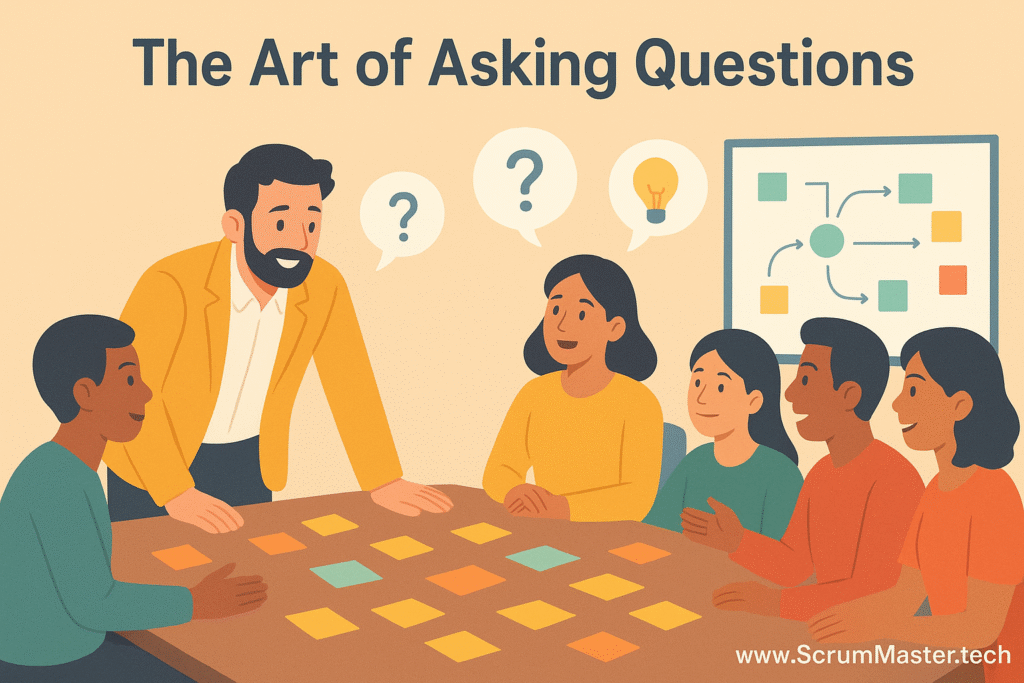
As Scrum Masters, we often think our role is about facilitating meetings, resolving conflicts, and coaching the team. While these are vital, there’s an understated skill that can completely transform your impact — the art of asking the right questions. Good questions have the power to shift perspectives, uncover hidden truths, and spark self-awareness. Great questions, however, go further — they challenge assumptions without causing defensiveness, invite collaboration instead of compliance, and open doors to possibilities the team didn’t see before. Why Questions Matter More Than Answers Many Scrum Masters, especially early in their journey, feel pressured to have answers to every situation. But in reality, having the answer is not always the most valuable thing you can bring. In Agile environments, self-organization is a core principle. If the Scrum Master becomes the source of every solution, the team’s growth is stunted. When you ask the right question instead, you: The Different Levels of Questions Not all questions are created equal. Here’s a quick breakdown: The magic is in knowing when to use each. When Silence is Part of the Question A common mistake Scrum Masters make is jumping in too quickly after asking a question. That awkward pause you feel? That’s thinking time. Pro tip: Ask your question… and wait. Count to five in your head. Let the discomfort sit. More often than not, someone will fill the silence with an insight you would never have arrived at by yourself. Questions that Transform Retrospectives Retrospectives are a Scrum Master’s prime opportunity to use questioning as a catalyst for change.Instead of the standard “What went well? What can we improve?”, try: The Pitfall: Questions that Disempower Not every question is helpful. Avoid: The goal is to open the door, not push people through it. Becoming a Question Artist Mastering the art of asking questions isn’t about memorizing a list. It’s about being curious without judgment.It’s about being comfortable with not knowing and creating a space where the team feels safe to explore. When done well, asking the right questions turns you from a process enforcer into a thought partner — someone who doesn’t just help the team deliver, but helps them grow. Final Thought:In Agile, change doesn’t always start with an action. Sometimes, it starts with a question. The right one can shift a conversation, transform a mindset, and, over time, change a culture.

Agile and Scrum Master Training online by ScrumMaster.Tech
Blog

Escaping the Servant Trap: Becoming a True Leader in Agile

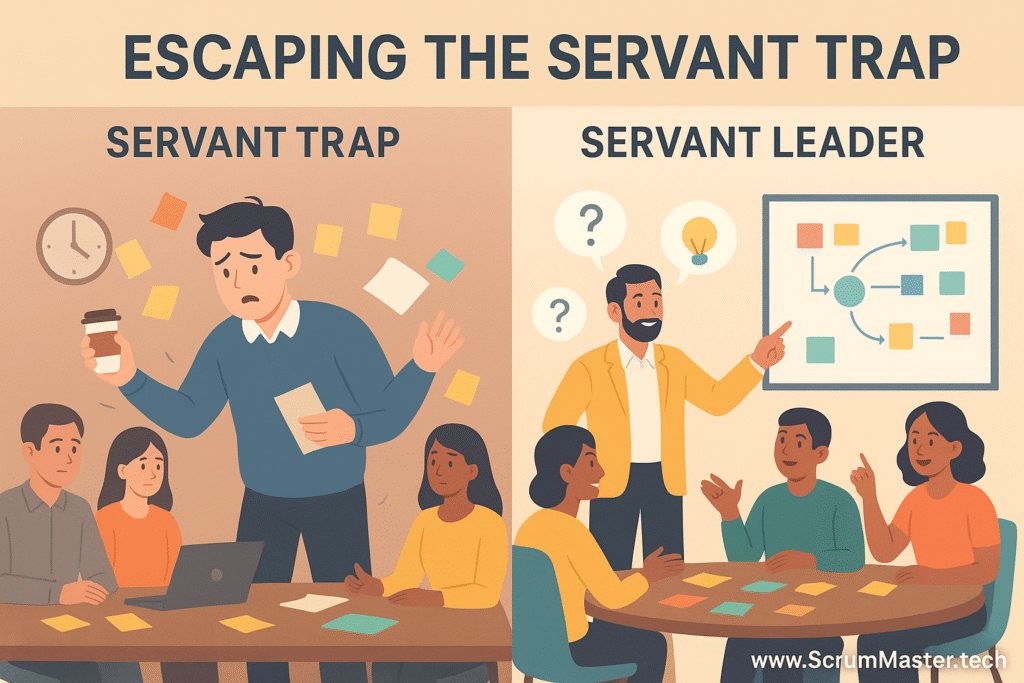
If you’ve been a Scrum Master for a while, you’ve probably heard the term “Servant Leader” more times than you can count.It’s one of the most defining characteristics of the role — supporting the team, removing impediments, and enabling their success. But here’s the catch:Many Scrum Masters fall into what I call the Servant Trap — becoming so focused on serving that they forget about leading. What is the Servant Trap? The Servant Trap happens when a Scrum Master: In this trap, you stop being a change agent and start becoming a passive helper — and Agile loses its edge. Why is it Dangerous? When you stay in the Servant Trap: Signs You’re in the Trap How to Escape the Servant Trap 1. Shift from “doing” to “enabling.”Instead of removing every impediment yourself, coach the team on how to navigate and solve their own blockers. 2. Balance empathy with accountability.A good Scrum Master cares for the team but also holds them responsible for delivering value and adhering to Agile principles. 3. Become a change leader, not a task manager.Focus on influencing the system — challenging outdated processes, fostering a culture of transparency, and advocating for agility at the organizational level. 4. Develop your leadership stance.Ask yourself: Am I here to please, or am I here to improve?Sometimes, leadership means making tough calls that aren’t immediately popular. 5. Measure growth, not gratitude.Your goal is not to be liked but to see the team grow in autonomy, collaboration, and delivery. The Real Meaning of Servant Leadership True servant leadership is not servitude.It’s about serving the purpose, not just the people — and guiding the team toward maturity, resilience, and continuous improvement. By escaping the Servant Trap, you reclaim your role as a leader who empowers change, not just a helper who gets things done. Remember: A Scrum Master’s value is not in how many problems you solve, but in how many problem-solvers you create.

product owner and Agile and Scrum Master Training online by ScrumMaster.Tech
Blog

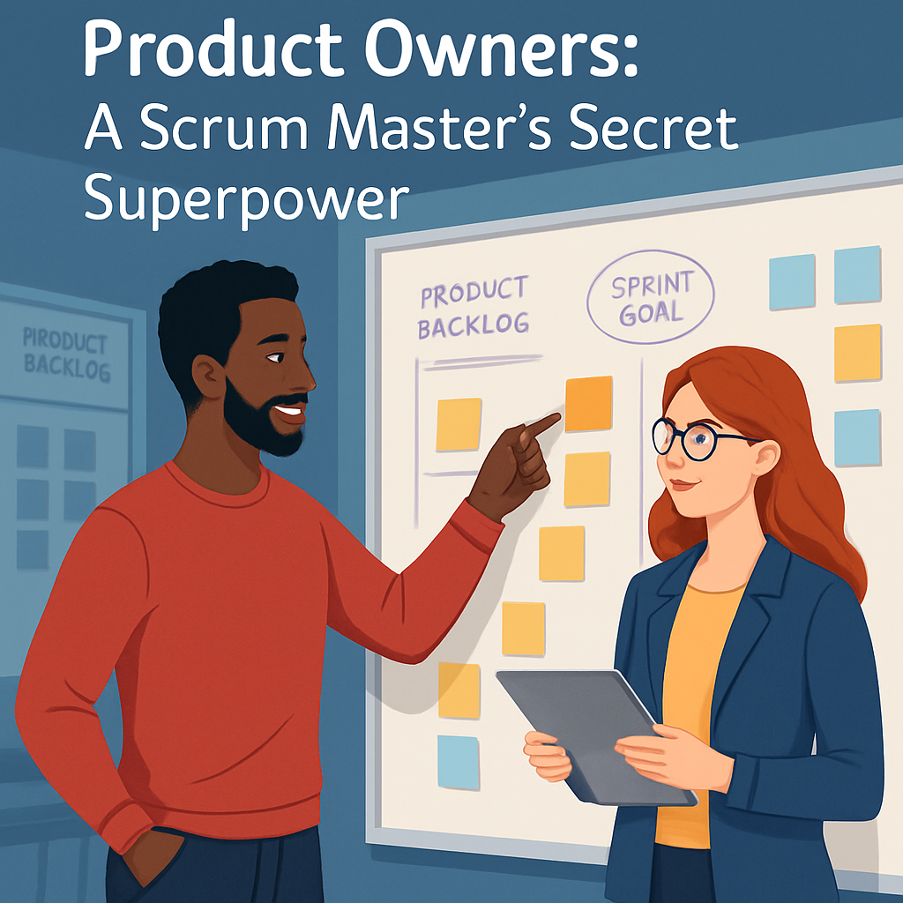
Coaching Product Owners: A Scrum Master’s Secret Superpower

As Scrum Masters, we’re trained to serve the team.But here’s the truth that seasoned coaches quietly know: “Your biggest multiplier isn’t the team — it’s the Product Owner.” When you coach your PO well, everything gets better: But… most Scrum Masters avoid it. Why POs Are Hard to Coach But this is exactly where an experienced Scrum Master becomes a quiet force multiplier. What Advanced Coaching Looks Like It’s not telling the PO how to write stories.It’s helping them think better about what matters most. Example Conversations: Coaching Prompt Purpose “What makes this story truly valuable?” Shift from tasks to outcomes “If you had to remove one backlog item today, which one?” Test prioritization clarity “How will we know if this release worked?” Focus on measurable outcomes “What feedback loops do we lack?” Inspire systems thinking When I Started Coaching My PO… In one org, the PO was seen as a bottleneck.The team grumbled about unclear stories, rework, wasted effort. Instead of blaming, I asked: “What would it look like if we planned the backlog together — not just you writing, but us clarifying together?” We tried it for 3 sprints. The backlog turned from a dumping ground into a shared product narrative. Tools That Help Takeaways Final Thought from Coach: “If you want better sprints, start by building a stronger partnership with your Product Owner.” 🔗 More Scrum wisdom at: www.ScrumMaster.tech/knowledge-hub

Agile and Scrum Master Training online by ScrumMaster.Tech
Blog

Agile is a Culture – Not Just a Framework

When most people hear the word Agile, they immediately think of frameworks like Scrum, Kanban, or SAFe. While these are valuable tools, they are only part of the picture. True Agile is not a set of rules or a checklist—it’s a culture. Beyond Processes and Tools Many teams adopt Agile practices but still struggle to achieve its benefits. Why? Because they focus on ceremonies and artifacts rather than the mindset that drives them.Agile culture is built on values and principles—collaboration, transparency, continuous learning, and adaptability. Without these, even the most perfectly executed Scrum will feel mechanical and hollow. A Mindset Shift Agile culture means: It’s a shift from “following the plan” to “finding the best path as we go.” Culture Shapes Behavior When Agile is treated as a culture, it changes how people behave every day: This cultural foundation creates an environment where innovation thrives and where delivering customer value becomes second nature. Frameworks Serve the Culture Scrum, Kanban, or any other Agile framework should serve the culture—not replace it.A team with an Agile mindset can succeed even with minimal process.A team without it will struggle, even with every Agile ceremony in place. How to Nurture Agile Culture In the end, Agile is not what you do—it’s how you think and how you work together.If your culture embraces trust, learning, and adaptability, Agile will naturally follow.

Agile and Scrum Master Training online by ScrumMaster.Tech
Blog

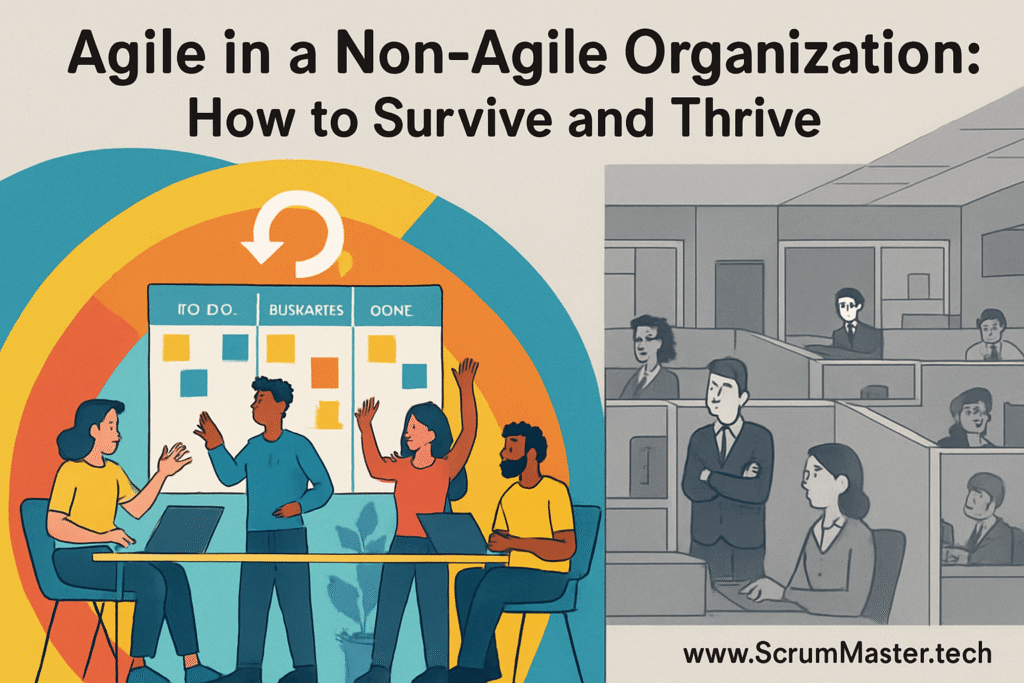
Agile in a Non-Agile Organization: How to Survive and Thrive

We read about empowered teams, fast feedback loops, and autonomous delivery in the Agile books. But reality? You’re running Scrum in a company that still works like it’s 2003. If you’ve ever felt like the only Agile person in the building — you’re not alone. What You’re Really Dealing With You’re trying to introduce adaptability into a system built for predictability and control. Common Struggles for Scrum Masters in Legacy Environments It’s frustrating — but not impossible. The Survival Playbook 1. Start Small, Go Deep Don’t aim to “transform” the org. Aim to create a pocket of real agility in one team. Focus on principles: 2. Manage Expectations Transparently Speak two languages: Use terms like: 3. Coach Laterally, Not Just Down Your biggest impact may come from influencing: 4. Create Visible Wins Nothing silences skeptics like results: Personal Reflection from Coach: I once worked with a team doing great Agile delivery — within a project governance model built for waterfall. Instead of fighting leadership, I reframed our reviews. “Here’s how fast we’re testing your assumptions.”“Here’s what we learned — and how it’s saving money.” Gradually, we earned the space to be Agile — not just do Agile. Takeaways Final Thought from Coach: “In a non-agile environment, the Agile mindset is your biggest asset — not your ceremonies.” Explore more blogs at: www.ScrumMaster.tech/knowledge-hub

Agile and Scrum Master Training online by ScrumMaster.Tech
Blog

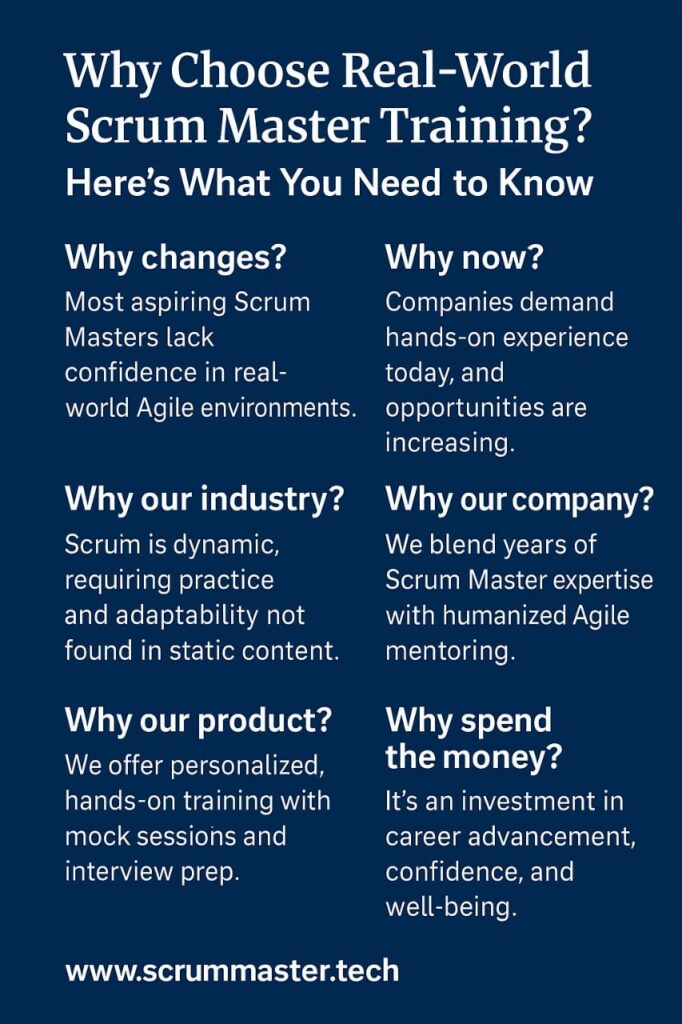
Why Choose Real-World Scrum Master Training? Here’s What You Need to Know

Introduction Becoming a confident Scrum Master isn’t just about earning a certificate. It’s about becoming capable in the real world — leading teams, facilitating change, and navigating the unpredictability of Agile environments. At ScrumMaster.tech, we believe in answering the real questions professionals have before investing time and money. Here are the six “Why” questions that matter most — and our honest answers to each. 1. Why Changes? What is undesirable about the potential buyer’s current situation?Most aspiring Scrum Masters are stuck in the theory trap. They’ve taken a course or read a book, but when it’s time to lead a stand-up, run a retro, or handle team conflict — they freeze. There’s a confidence gap. With practical exposure, guidance, and mock experiences we close that gap. 2. Why Now? Why is it so pressing to make those changes today?The market is moving fast.Scrum roles are increasing — but so is the competition. Every month you delay means more candidates with practical knowledge ahead of you.Don’t wait until your dream role is posted. Be ready before it happens. 3. Why Our Industry? Books, videos, and online courses exist — so why real-time, practical training?Because Scrum isn’t theoretical. It’s experiential.Static content can’t simulate real team dynamics.We deliver: Hands-on problem solving Simulated Scrum events One-on-one mentoring You don’t just learn. You do. 4. Why Me? What makes ScrumMaster.tech different? Backed by 18+ years of IT experience and 7+ years as a Scrum Master Designed to bridge the gap between theory and practice Focused on individual growth, not just content delivery We treat Agile as human, not mechanical. That’s our edge. 5. Why Our Product? It’s a mentoring-driven journey.You’ll get: Live guidance Interview prep Real-world case simulations Group sessions and retrospectives You’ll leave the program not just ready — but confident. 6. Why Spend the Money? What’s the real value? Career boost: Move into or grow within Agile leadership roles Confidence: Handle interviews and real teams with assurance Time saved: Avoid years of trial-and-error learning Peace of mind: You’ll no longer feel like an imposter This isn’t a cost. It’s an investment in a better future. Final Thoughts If you’re seeking a program that gets you job-ready, boosts your confidence, and shows you how to thrive as a Scrum Master — you’re already in the right place. Reach Us to get started.

Agile and Scrum Master Training online by ScrumMaster.Tech
Blog

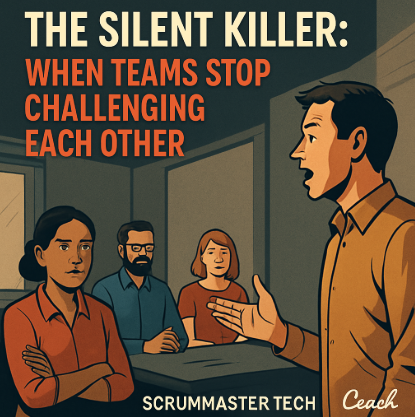
The Silent Killer: When Teams Stop Challenging Each Other

Many Scrum Masters fear conflict.But the real danger isn’t disagreement — it’s silence. Early in my career, I celebrated quiet teams.“No drama,” I thought. “They get along.” But over time, I realised something deeper was happening:They weren’t getting along. They were checked out. The Hidden Dysfunction: Artificial Harmony Teams that stop debating ideas…That stop questioning stories…That nod along in retros… They’re not “mature.”They’re stuck in artificial harmony. They fear tension more than they value truth. Real-Life Signs of a Stagnant Team Retrospectives are short and superficial Planning sessions lack debate The same person always speaks — and no one challenges Decisions are made without diverse input Conflict avoidance is disguised as “team bonding” The Psychology Behind It Past trauma: Maybe past feedback was punished Leader shadows: A dominating voice makes others shrink Safety deficit: No trust, no challenge False peace: Confusion between kindness and agreement What an Advanced Scrum Master Can Do Name the Silence “I’ve noticed we haven’t had many differing opinions lately — is that because we’re aligned or avoiding friction?” Create Micro-Permissions Ask: “What’s a safe-to-challenge idea this sprint?” Model it: Challenge a harmless norm and invite response Protect the Challenger Praise dissent Reinforce constructive disagreement Redirect defensiveness gently Retrospective Prompt: “What are we not saying?” Sometimes the most important topics are the ones unspoken A Moment That Changed Me A developer once told me privately: “I have feedback, but I don’t want to be that guy.” That line shook me.Because “that guy” is exactly who high-performing teams need. So I started ending my retros with:“Who wants to be that guy today — with love?” And it worked. Takeaways Conflict is not dysfunction — it’s evidence of trust Psychological safety isn’t just feeling nice — it’s speaking truth Teams that challenge each other grow — those that don’t, rot Final Thought from Coach: “A silent team is not a healthy team. It’s a team that’s stopped caring enough to speak.” 🔗 Explore more deep-dive blogs at: www.ScrumMaster.tech/knowledge-hub

Scrum Master Training online by ScrumMaster.Tech
Empowering Agile Teams. Transforming Deliveries. Learn Scrum from real-world experience, not just theory.

coach@scrummaster.tech

© 2025 ScrumMaster. All Rights Reserved.

Scroll to Top