If you’ve been a Scrum Master for a while, you’ve probably heard the term “Servant Leader” more times than you can count.
It’s one of the most defining characteristics of the role — supporting the team, removing impediments, and enabling their success.
But here’s the catch:
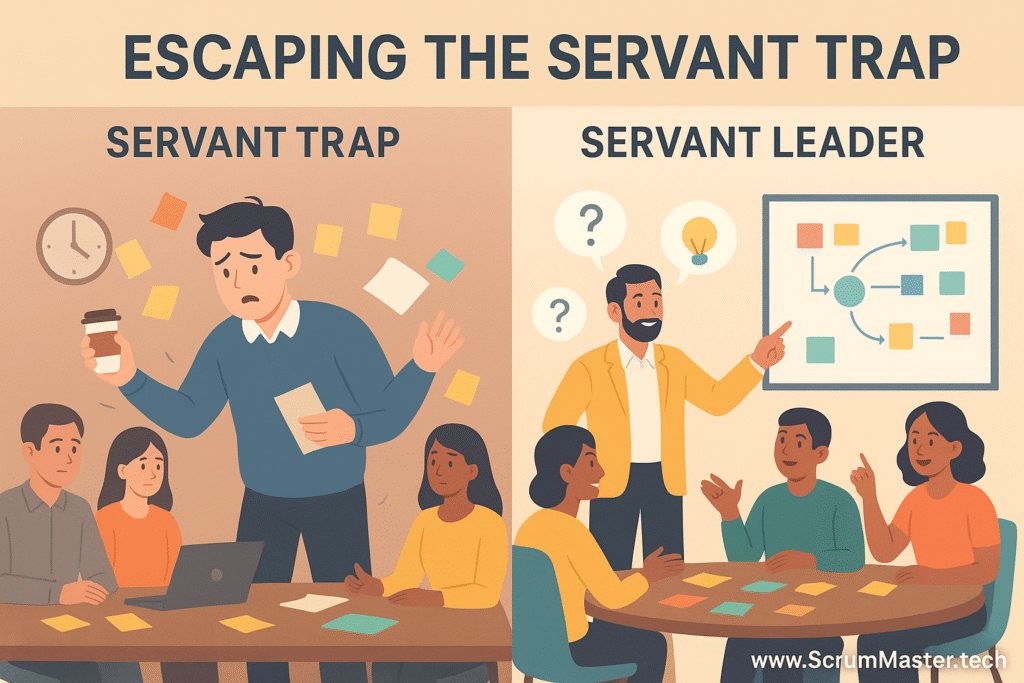
Many Scrum Masters fall into what I call the Servant Trap — becoming so focused on serving that they forget about leading.
What is the Servant Trap?
The Servant Trap happens when a Scrum Master:
- Turns into an errand-runner for the team instead of a coach.
- Avoids tough conversations to “keep everyone happy.”
- Focuses solely on immediate requests rather than long-term improvements.
- Measures success only by “Did I solve their problems?” instead of “Did I help them solve their own problems?”
In this trap, you stop being a change agent and start becoming a passive helper — and Agile loses its edge.
Why is it Dangerous?
When you stay in the Servant Trap:
- The team becomes dependent on you instead of growing self-organizing skills.
- Organizational impediments never get challenged because you avoid conflict.
- Your influence shrinks — you’re seen as a support role, not a leader.
- Burnout risk skyrockets because you’re always fixing instead of facilitating.
Signs You’re in the Trap
- You’re constantly busy but not making visible progress toward team maturity.
- You rarely push back or say “no” when the team’s requests are outside your role.
- You spend more time scheduling meetings, taking notes, or chasing updates than driving Agile adoption.
- You avoid addressing dysfunctions because it might upset people.
How to Escape the Servant Trap
1. Shift from “doing” to “enabling.”
Instead of removing every impediment yourself, coach the team on how to navigate and solve their own blockers.
2. Balance empathy with accountability.
A good Scrum Master cares for the team but also holds them responsible for delivering value and adhering to Agile principles.
3. Become a change leader, not a task manager.
Focus on influencing the system — challenging outdated processes, fostering a culture of transparency, and advocating for agility at the organizational level.
4. Develop your leadership stance.
Ask yourself: Am I here to please, or am I here to improve?
Sometimes, leadership means making tough calls that aren’t immediately popular.
5. Measure growth, not gratitude.
Your goal is not to be liked but to see the team grow in autonomy, collaboration, and delivery.
The Real Meaning of Servant Leadership
True servant leadership is not servitude.
It’s about serving the purpose, not just the people — and guiding the team toward maturity, resilience, and continuous improvement.
By escaping the Servant Trap, you reclaim your role as a leader who empowers change, not just a helper who gets things done.
Remember: A Scrum Master’s value is not in how many problems you solve, but in how many problem-solvers you create.