Velocity.
That sacred number we display on dashboards.
That trend line we present in reviews.
But here’s the brutal truth:
Teams can hit their velocity target and still deliver zero value.
I’ve seen teams sprint hard, burn story points like champs…
Only to discover that what we built wasn’t needed, wasn’t used, or wasn’t usable.
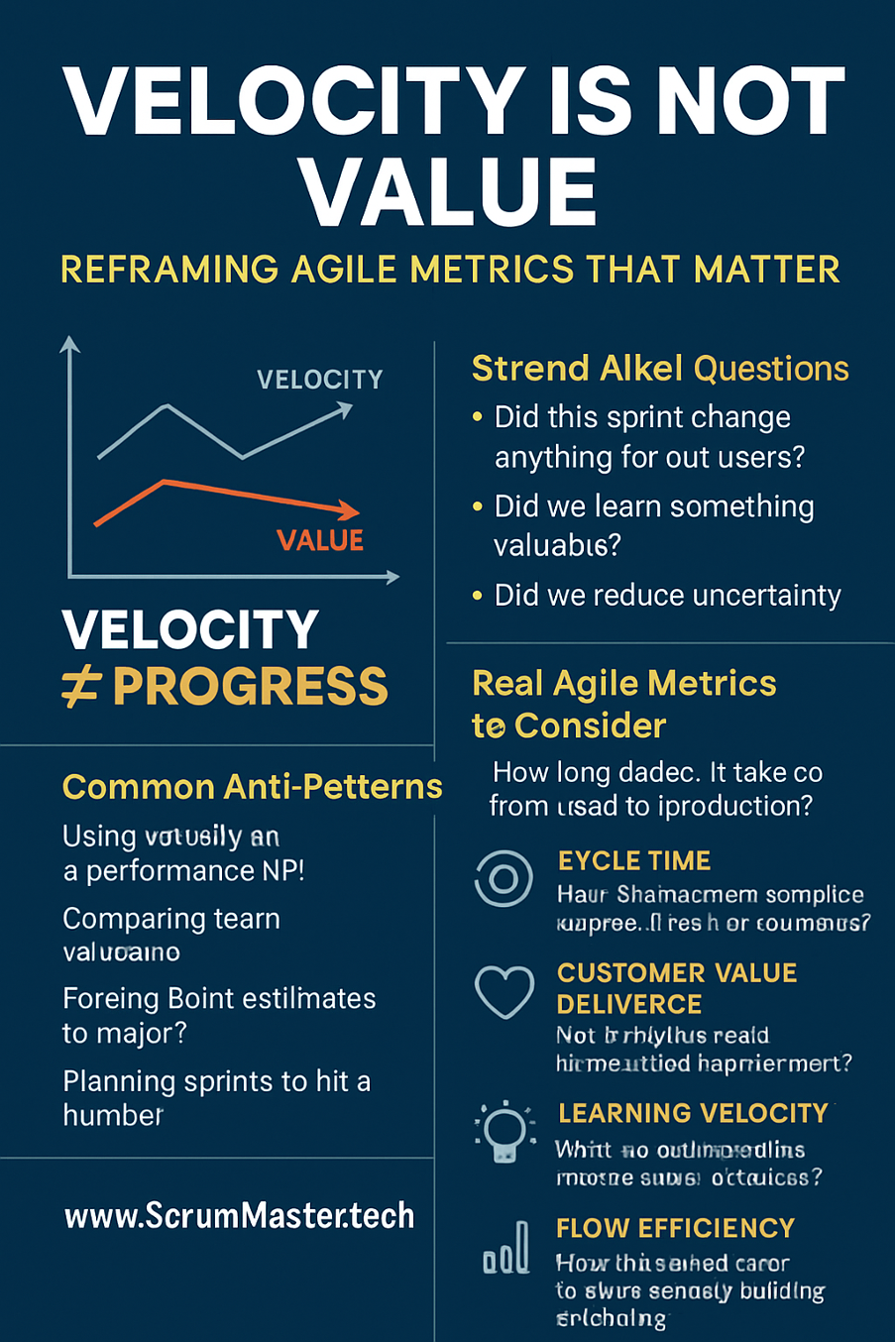
Velocity ≠ Progress
Velocity is a measure of motion — not of meaning.
We’ve confused speed with significance.
Just because we’re moving, doesn’t mean we’re moving in the right direction.
Let’s Ask the Real Questions
Instead of:
“Did we hit our velocity goal?”
Try:
- “Did this sprint change anything for our users?”
- “Did we learn something valuable?”
- “Did we reduce uncertainty?”
Common Anti-Patterns
| Anti-Pattern | Why It’s Harmful |
| Using velocity as a performance KPI | Encourages gaming the metric |
| Comparing team velocities | Violates team autonomy & context |
| Forcing point estimates to match | Creates false precision |
| Planning sprints to ‘hit a number’ | Ignores actual need & flow |
Real Agile Metrics to Consider
- Lead Time
How long does it take to go from idea to production?
- Cycle Time
How fast can a team complete a piece of work once it starts?
- Customer Value Delivered
Did this sprint result in real-world improvement?
- Learning Velocity
What did we learn that informs better decisions?
- Flow Efficiency
How much of our time is spent actually building vs. waiting?
A Shift I Made as a Scrum Master
In one org, leadership was obsessed with points.
Sprint after sprint, teams “performed” well — but usage dropped.
So I ran a silent retro:
“If velocity were invisible, how would we measure success?”
The results were raw:
- “Customer feedback.”
- “Uptime stability.”
- “Our own excitement.”
That was the moment we stopped estimating and started evolving.
What You Can Do As an Advanced Scrum Master
- Educate stakeholders on what velocity is (and isn’t)
- Surface user impact during sprint reviews
- Introduce dual metrics — speed and value
- Celebrate iterations that reduce uncertainty, not just complete tasks
- Track learning outcomes in retrospectives
Takeaways
- Velocity is a useful trend, not a success metric
- Real agility is measured by impact, not inertia
- Value is what changes lives — not what fills burn-down charts
Final Thought from Coach:
“Agile is not about doing more. It’s about doing what matters — and doing it wisely.”
More insights at:
www.ScrumMaster.tech/knowledge-hub